
Your cart is currently empty!

For some reason a year ago I decided to have us learn about Madagascar. I think it might have been one of my last Cooking Around the World with others. I’m not really sure why, but we cooked Madagascar chicken. Now, I’d stayed away from African cuisine after a couple of very disastrous early attempts where no one would eat it, and so I picked a very bland recipe. This Madagascar Chicken recipe is the perfect recipe to start your picky kid cooking around the world.

(I’ve got some affiliate links in here)
- Madagascar Chicken recipe ingredients
- chicken leg quarters, the original recipe called for 4, but I doubled it to at least 10 because 5 people and all that
- 4 inches ginger peeled and grated (I just minced it up super small)
- zest of one lemon (for my size recipe it should be two, but my husband isn’t big on lemon flavored meat)
- 6 garlic cloves
- onion diced (I’ve started essentially mincing onions since I’m not a big fan of the texture)
- coconut oil
- 2 orange bell peppers (I think I forgot this, because looking at the pictures, I’m not seeing any)
Cooking your Madagascar Chicken
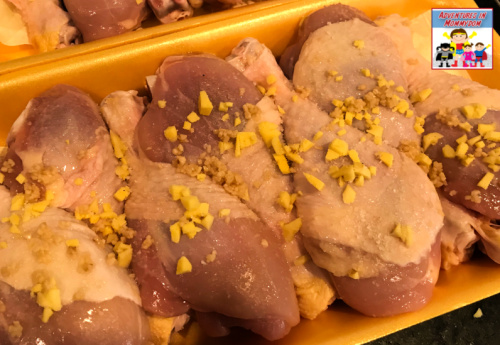
- Rub your lemon zest, ginger, and garlic over chicken. NOW, if you’ve read the instructions the day before, you’ve figured out this needs to be marinated overnight. Now, I looked at the recipe earlier in the day, and it only marinated in it for a few hours. So…… Your call on that one.
- In your skillet heat the coconut oil. Because I had lots and lots of chicken, I cooked it in two pans. Coconut oil is one of my subscribe and save items on Amazon. I get a giant tub mailed to me every 3 or so months (maybe it’s 4 months), and I use it for lots of different things.
- Brown your chicken on all sides, then remove it and cook the onion and bell peppers.
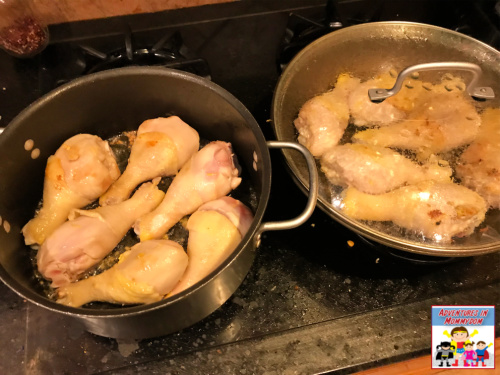
- Once the onion and bell pepper are cooked down a little, add the chicken back in, cover it, and cook for about 45 minutes until it’s about falling off the bone.
- Serve over rice, or as we did. I bought some of those fun mini-potatoes and we fried them up, and they made a great side dish to go with this chicken.
Our Madagascar booklist
Oh wait! I think we decided to study because my kids had been watching the Wild Kratts show in Madagascar! That would also explain why every book we got was based on animals….

- Aye-ayes– these guys have crazy eyes!
- Flying Lemurs– these guys fascinate me
- Follow Me!– super cute lemur follow the leader book
- How to Lose a Lemur– a silly board book
- Lemurs on Location– the pictures in this book are amazing
Biology students love Madagascar because it’s a contained environment with such a wide variety of creatures on it. My kids love it because it’s got so many creatures on it, and they love all of those crazy primates.
More Geography fun with your kids!


Comments
6 responses to “Madagascar Chicken recipe”
I’ve never thought to marinate our meat on the butcher trays they come on. I always dirty one of my casserole dishes. I think you might be brilliant 🙂
Totally by accident, if it requires any sort of sauce, it always ends up in a ziploc bag.
This looks really yummy! Too bad that my husband does not like bones, so my chicken recipes have to use breasts every single time 🙁
Oh, that would limit what you can make for sure. I would think you could make this recipe, just wouldn’t be quite as good with chicken breasts versus the chopped up chicken.
I think the original recipe calls for 4 chicken leg quarters which is a bigger piece of meat than just the leg. It’s the leg and thigh attached .
You are probably right, at the time I first cooked it, I wasn’t too familiar with how to cook chicken quarters, but now I would probably do that version.


Leave a Reply